Breeding records of the Elf Owl (Micrathene whitneyi) in Mexico
DOI:
https://doi.org/10.28947/hrmo.2026.27.1.841Keywords:
birds, brood patch, nesting, owls, reproduction, StrigidaeAbstract
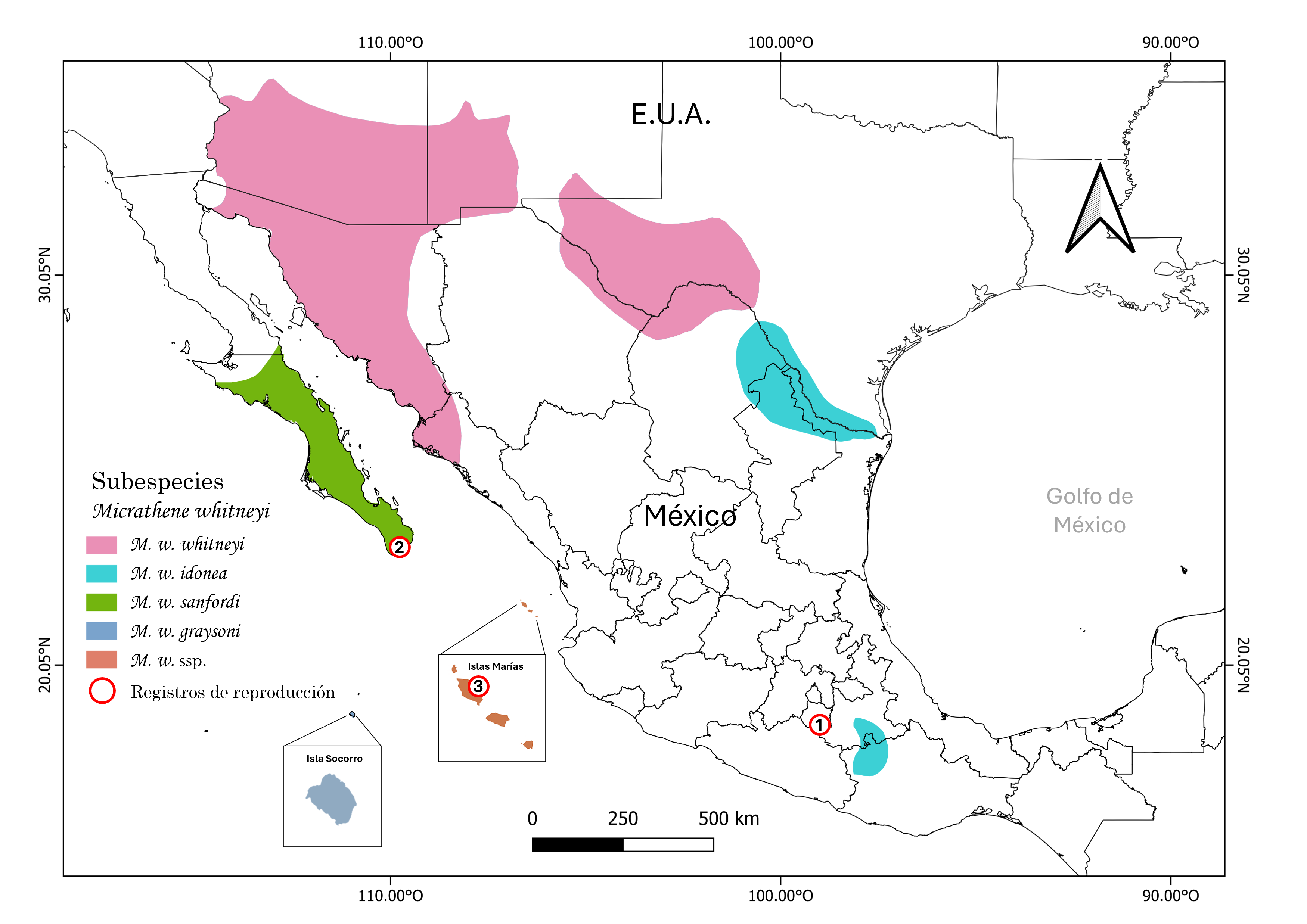
The reproductive biology of the Elf Owl (Micrathene whitneyi) has been poorly documented within Mexican territory, with reproductive populations known only along the border between Mexico and the United States of America. As part of a phylogeographic study of the species, we captured Elf Owls at three localities in Mexico, between April and August 2024. We determined the age, sex, and reproductive status by stage of the brood patch of captured birds. We registered four individuals showing signs of reproduction in three Mexican localities: two females with brood patches in Baja California Sur; one female with a brood patch and an active nest in Morelos; and a juvenile on Isla María Madre in Nayarit. These findings expand the known breeding range of the Elf Owl to include central geographic regions of the country where reproduction had not previously been documented, suggesting the potential existence of additional reproductive populations in Mexico.
Downloads
References
Barlow JC, Johnson R. 1967. Current status of the Elf Owl in the southwestern United States. Southwestern Naturalist 12:331-332. https://doi.org/10.2307/3669121
Bent AC. 1938. Life histories of North American birds of prey. Part 2: Orders Falconiformes and Strigiformes. National Museum Bulletin 170. Washington, D.C., USA.
BirdLife International. 2021. Species factsheet: Elf Owl Micrathene whitneyi. https://datazone.birdlife.org/species/factsheet/elf-owl-micrathene-whitneyi (consultado el 05 de febrero del 2025)
Brown H. 1904. The Elf Owl in California. The Condor 6:45-47. https://doi.org/10.2307/1361557
Cisneros-Palacios E, Bonilla-Ruz C. 1993. New distributional information on Mexican birds III: Northern Oaxaca. Bulletin of the British Ornithologists' Club 113:213-215.
CONANP (Comisión Nacional de Áreas Naturales Protegidas). 2021. Programa de Conservación y Manejo Reserva de la Biosfera Islas Marías. Secretaría de Medio Ambiente y Recursos Naturales (SEMARNAT). Ciudad de México, México.
DeSante DF, Burton KM, Kaschube DR, Velez P, Froehlich D, Albert S. 2022. MAPS Manual: 2022 Protocol. The Institute for Bird Populations. Point Reyes Station, California, USA.
Flores-Dimas, C. 2016. Distribución y abundancia de Micrathene whitneyi (Aves:Strigidae) en el rancho El Jabalín, Oaxaca, México. Tesis de Licenciatura. Universidad Autónoma del Estado de México. Toluca, Estado de México, México.
Gamel CM, Brush T. 2001. Habitat use, population density, and home range of elf owls (Micrathene whitneyi) at Santa Ana National Wildlife Refuge, Texas. Journal of Raptor Research 35:214-220.
Henry SG, Gehlbach FR, Molfetto D, Howard P. 2020. Elf Owl (Micrathene whitneyi), versión 1.0. En Billerman SM (ed). Birds of the world. Cornell Lab of Ornithology, Ithaca, Nueva York, USA. https://doi.org/10.2173/bow.elfowl.01
Johnsgard PA. 1988. North American owls: biology and natural history. Smithsonian Institution Press, Washington, USA.
Legaspi-Moranchel A. 2019. Diagnóstico ecológico y social sobre los Strigiformes en la UMA del Ejido rancho El Salado, Jolalpan, Puebla. Tesis de Licenciatura. Benemérita Universidad Autónoma de Puebla. Puebla, Puebla, México.
Legaspi-Moranchel A. 2022. Ocupación y uso de hábitat de las aves nocturnas en la Reserva de la Biósfera Sierra de Huautla, Morelos, México. Tesis de Maestría. El Colegio de la Frontera Sur, San Cristóbal de las Casas, Chiapas, México.
Ligon JD. 1967. The biology of the Elf Owl, Micrathene whitneyi. Ph.D. thesis. University of Michigan. Ann Arbor, Michigan, USA.
Muller KA. 1970. Exhibiting and breeding Elf Owls (Micrathene whitneyi) at Washington Zoo. International Zoo Yearbook 10:33-36. https://doi.org/10.1111/j.1748-1090.1970.tb01265.x
Navarro S. 2024. La difícil tarea de la conservación de la biodiversidad, el caso de la Reserva de la Biósfera Islas Marías. Revista Mexicana de Agroecosistemas 11(1):50-66. https://doi.org/10.60158/rma.v11i1.410
Northern JR. 1965. Notes on the owls of the Tres Marías Islands, Nayarit, Mexico. Condor 67:358.
Pyle P. 2022. Identification guide to North American birds: a compendium of information on identifying, ageing, and sexing "near-passerines" and passerines in the hand. Slate Creek Press. California, USA.
Pyle P, Gahbauer M, Johnson EI, Ryder TB, Wolfe JD. 2022. Application of a global age-coding system (“WRP”), based on molts and plumages, for use in demographic and other studies of birds. The Auk 139:ukab063. https://doi.org/10.1093/ornithology/ukab063
Ridgway R. 1886. Description of a new species of Elf Owl from Socorro Island, western Mexico. The Auk 3:333-334.
Ridgway R. 1914. The birds of north and middle America: A descriptive catalogue of the higher groups, genera, species, and subspecies of birds known to occur in North America, from the Arctic lands to the Isthmus of Panama, the West Indies and other islands of the Caribbean Sea, and the Galapagos Archipelago (No. 50). US Government Printing Office. Washington, D.C., USA.
Wehtje W, Walter HS, Rodríguez-Estrella R, Llinas, J, Castellanos-Vera A. 1993. An annotated checklist of the birds of Isla Socorro, Mexico. Western Birds 24:1-16.
Weick F. 2007. Owls (Strigiformes): annotated and illustrated checklist. Springer, Berlin, Heidelberg, Alemania. https://doi.org/10.1007/978-3-540-39567-6_2
Weidensaul CS, Colvin BA, Brinker DF, Huy JS. 2011. Use of ultraviolet light as an aid in age classification of owls. The Wilson Journal of Ornithology 123:373-377. https://doi.org/10.1676/09-125.1
Wilbur SR. 1987. The birds of Baja California. University of California Press. Berkeley, California, USA.
Downloads
Published
How to Cite
Issue
Section
License
Copyright (c) 2026 Claudia Cristina Valenzuela Inzunza, David Ramírez Adame, José Antonio Guerrero, José Emer García de la Puente Orozco, Rosa Gabriela Beltrán-López

This work is licensed under a Creative Commons Attribution-NonCommercial-NoDerivatives 4.0 International License.
Los autores/as que publiquen en Huitzil Revista Mexicana de Ornitología aceptan las siguientes condiciones:
a. Los autores/as conservarán sus derechos de autor y garantizarán a la revista el derecho de primera publicación de su obra, el cual estará simultáneamente sujeto a la licencia de atribución no comercial ni obras derivadas 4.0 (CC-BY-NC-ND 4.0) que permite a terceros compartir la obra siempre que se indique su autor y su primera publicación en esta revista.
b. Los autores/as pueden realizar otros acuerdos contractuales independientes y adicionales para la distribución no exclusiva de la versión del artículo publicado en esta revista (por ejemplo, incluirlo en un repositorio institucional o publicarlo en un libro) siempre que indiquen claramente que el trabajo se publicó por primera vez en Huitzil.
c. Se permite y recomienda a los autores/as a publicar su trabajo en Internet (por ejemplo, en páginas institucionales o personales) posterior al proceso de revisión y publicación, ya que puede conducir a intercambios productivos y a una mayor y más rápida difusión del trabajo publicado (vea The Effect of Open Access).