Abundance of Peninsular Belding’s Yellowthroat (Geothlypis beldingi) in La Ribera, Baja California Sur, Mexico
DOI:
https://doi.org/10.28947/hrmo.2026.27.1.871Keywords:
bird density, Distance sampling, oasis, Parulidae, threatened birdsAbstract
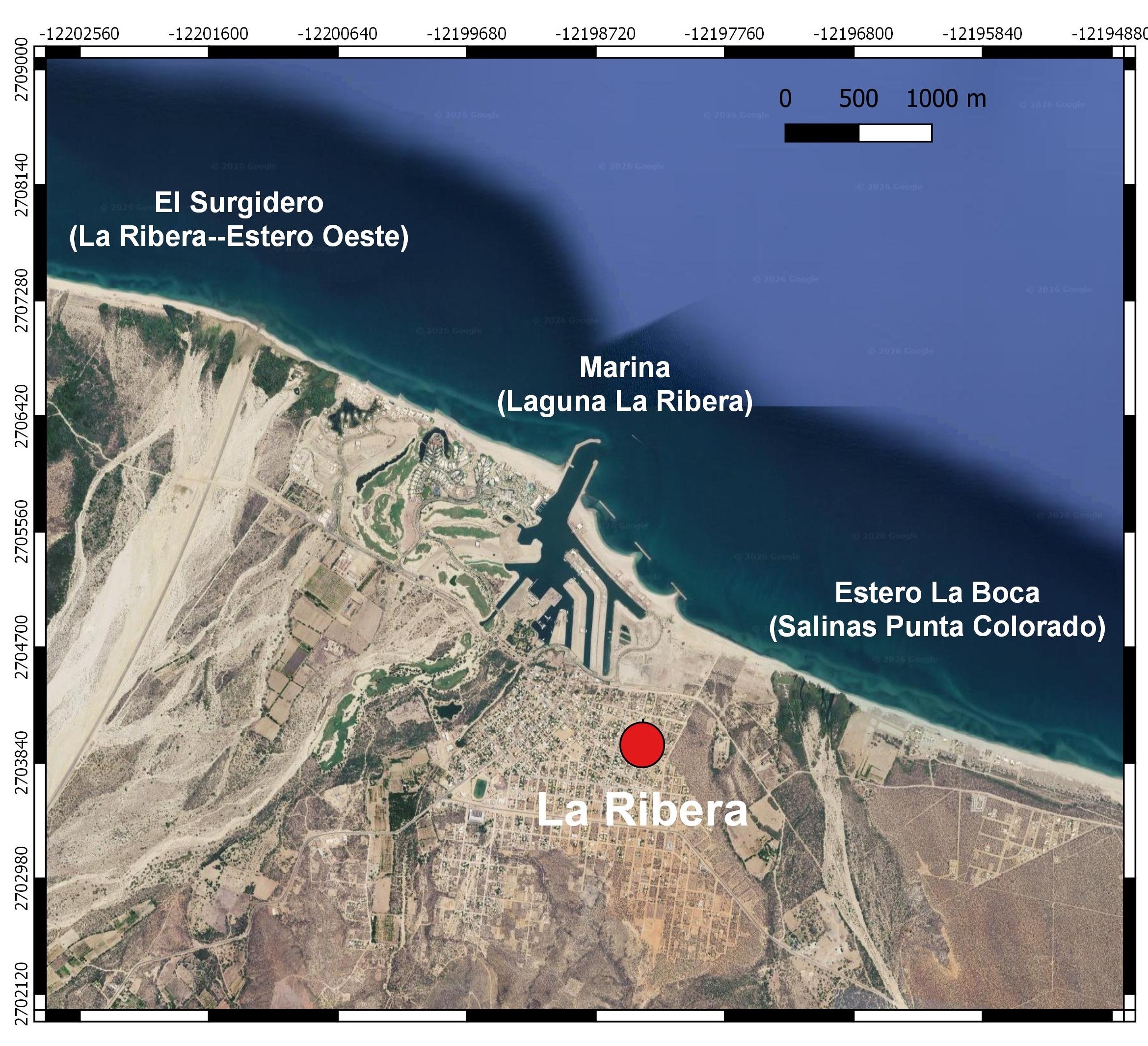
Belding’s Yellowthroat (Geothlypis beldingi) is an endangered species, endemic to the oases of Baja California Sur, Mexico, but with no records in the oases of La Ribera, southeast of the state. On 10 June 2025, we conducted 16 variable-radius point counts at the El Surgidero and Estero La Boca oases, adjacent to La Ribera, to document the presence of Belding’s Yellowthroat and provide a preliminary estimate of its abundance. Additionally, we measured the coverage of emergent vegetation (Phragmites australis, Typha domingensis, and Arundo donax), the obligate habitat of Belding’s Yellowthroat. We recorded 41 birds of Belding’s Yellowthroat: 24 at El Surgidero and 17 at Estero La Boca. Using Distance sampling analysis, we estimated a density of Belding’s Yellowthroat of 12.12 ind/ha (95% CI: 5.82 – 25.23 ind/ha), with a detection radius of 25.9 m. The area of suitable habitat in the two oases was 7.04 ha combined, leading us to estimate a population of 85 birds (95% CI: 41-178 birds). This population accounts for between 5.1% and 13.1% of the total estimated population for the species, but is threatened by human activities, which necessitates the implementation of conservation actions.
Downloads
References
Ávila-Flores G, Paredes-Lozano L, Hernández-Hernández E, Hernández-Morales P. 2025. A vision for collaboration: preserving ecosystem services through blue carbon research between Mexico and China, a case study in La Ribera, Baja California Sur. Anthropocene Coasts 8:10. https://doi.org/10.1007/s44218-025-00077-x
Brewster W. 1902. Birds of the Cape Region of Lower California. Bulletin of the Museum of Comparative Zoology 41:1-241.
Carmona R, Marrón G, Águila S, Rivas A, Flores-Ramírez S, Reyes-Bonilla H. 2020. Population assessment of Belding’s Yellowthroat (Geothlypis beldingi) at San Ignacio oasis, Baja California Sur, Mexico. Western Birds 51:38-46. https://doi.org/10.21199/WB51.1.3
Carmona R, Marrón G, Águila S, Mata I, Pérez S, Alcalá S, Ávalos S, Mendoza A, Flores E, González D, Flores Ramírez S. 2025. Update on the breeding distribution of Belding’s Yellowthroat (Geothlypis beldingi). Western Birds 56:74-85. https://doi.org/10.21199/WB56.2.1
Córdova-Rojas IB, Rodríguez-Estrella R, RuizCampos G, Escalante-Pliego P. 2024. Revisión de la distribución, abundancia y amenazas de la mascarita peninsular (Geothlypis beldingi), en Baja California Sur, México (Passeriformes, Parulidae). Acta Zoológica Mexicana (nueva serie) 40:1-14. https://doi.org/10.21829/azm.2024.4012618.
Coria R. 1997. Climatología. Pp. 27-34. En Arriaga L, Rodríguez-Estrella R (eds.). Los oasis de la península de Baja California. Centro de Investigaciones Biológicas del Noroeste. La Paz, Baja California Sur, México.
eBird. 2025. eBird: An online database of bird distribution and abundance. Cornell Lab of Ornithology, Ithaca, New York, USA. https://ebird.org (consultado 30 de agosto de 2025).
Erickson RA, Hamilton RA, Mlodinow SG. 2008. Status review of Belding's Yellowthroat Geothlypis beldingi, and implications for its conservation. Bird Conservation International 18:219-228. https://doi.org/10.1017/S0959270908000221
Escalante-Pliego P. 2000. Mascarita peninsular. Pp. 304-305. En Ceballos G, Valdelamar Márquez L (eds.). Las aves de México en peligro de extinción. Comisión Nacional para el Conocimiento y Uso de la Biodiversidad, Instituto de Ecología, Universidad Nacional Autónoma de México, Fondo Cultura, CDMX, México.
Google. 2026. Google Earth Pro. Imágenes satelitales de El Surgidero y Estero La Boca, La Ribera, Baja California Sur, México. Google LLC. Disponible en: https://earth.google.com/ (consultado el 22 de agosto de 2026).
Graciano JC, Ángeles M, Gámez AE. 2020. A critical geography approach to land and water use in the tourism economy in Los Cabos, Baja California Sur, Mexico. Journal of Land Use Science 15:439-456. https://doi.org/10.1080/1747423X.2019.1699613
Grinnell J. 1928. A distributional summation of the ornithology of lower California. University of California Publications in Zoology 32:1-300.
Howell SNG, Webb S. 1995. A guide to the birds of Mexico and northern Central America. Oxford University Press, New York, USA.
INEGI. 2023. Censo de población y vivienda (2020). Principales resultados del Censo de Población y Vivienda 2020: Baja California Sur. Instituto Nacional de Estadística y Geografía. Gobierno Federal. Aguascalientes, México.
IUCN. 2021. Geothlypis beldingi. The IUCN Red List of Threatened Species. International Union for Conservation of Nature https://www.iucnredlist.org/species/22721839/182929291 (consultado el 25 de agosto de 2025).
Marrón G, Carmona R. 2024. Belding's Yellowthroat (Geothlypis beldingi), version 2.0. En Sly ND (ed.). Birds of the World. Ithaca, NY: Cornell Lab of Ornithology. https://doi.org/10.2173/bow.belyel1.02.
Newell FL, Sheehan J, Wood PB, Rodewald AD, Buehler DA, Keyser PD, Larkin JL, Beachy TA, Bakermans MH, Boves TJ, Evans A, George GA, McDermott ME, Perkins KA, White MB, Wigley TB. 2013. Comparison of point counts and territory mapping for detecting effects of forest management on songbirds. Journal of Field Ornithology 84:270-286. https://doi.org/10.1111/jofo.12026
Rajpar MN, Zakaria M. 2010. Density and diversity of water birds and terrestrial birds at Paya Indah Wetland Reserve, Selangor Peninsula Malaysia. Journal of Biological Sciences 10:658–666.
Rodríguez-Estrella R, Rubio-Delgado L, Pineda-Diez de Bonilla E, Blanco G. 1999. Belding's Yellowthroat: current status, habitat preferences and threats in oases of Baja California, Mexico. Animal Conservation 2:77-84. https://doi.org/10.1111/j.1469-1795.1999.tb00052.x
Ruiz-Campos G, Andreu-Soler A, Vidal-Abarca MR, Delgadillo-Rodríguez J, Suárez AML, González-Abraham C, Luja VH. 2014. Catálogo de Humedales Dulceacuícolas de Baja California Sur, México. Instituto Nacional de Ecología y Cambio Climático–Secretaría de Medio Ambiente y Recursos Naturales, Ciudad de México.
SEMARNAT. 2010. Norma Oficial Mexicana NOM-059-SEMARNAT-2010, Protección ambiental-Especies nativas de México de flora y fauna silvestres-Categorías de riesgo y especificaciones para su inclusión, exclusión o cambio-Lista de especies en riesgo. Secretaría de Medio Ambiente y Recursos Naturales. Publicada el jueves 30 de diciembre de 2010. Diario Oficial de la Federación. Gobierno de México.
Thomas L, Laake JL, Rexstad E, Strindber S, Marques FFC, Buckland ST, Borchers DL, Anderson DR, Burnham KP, Burt ML, Hedley SL, Pollard JH, Bishop JRB, Marques TA. 2006. Distance 6.0. Release “x”. Research Unit for Wildlife Population Assessment, University of St. Andrews, UK.
Wilbur SR. 1987. Birds of Baja California. University of California Press, Berkeley, California, USA.
Zar JH. 2010. Biostatistical analysis. 5th. edition. Prentice-Hall, Nueva Jersey, USA.
Downloads
Published
Issue
Section
License
Copyright (c) 2026 Roberto Carmona, Gerardo Marrón, Sergio Alcalá, Selma Ávalos, Aranza Mendoza , Damián González, Sofía Macklis

This work is licensed under a Creative Commons Attribution-NonCommercial-NoDerivatives 4.0 International License.
Los autores/as que publiquen en Huitzil Revista Mexicana de Ornitología aceptan las siguientes condiciones:
a. Los autores/as conservarán sus derechos de autor y garantizarán a la revista el derecho de primera publicación de su obra, el cual estará simultáneamente sujeto a la licencia de atribución no comercial ni obras derivadas 4.0 (CC-BY-NC-ND 4.0) que permite a terceros compartir la obra siempre que se indique su autor y su primera publicación en esta revista.
b. Los autores/as pueden realizar otros acuerdos contractuales independientes y adicionales para la distribución no exclusiva de la versión del artículo publicado en esta revista (por ejemplo, incluirlo en un repositorio institucional o publicarlo en un libro) siempre que indiquen claramente que el trabajo se publicó por primera vez en Huitzil.
c. Se permite y recomienda a los autores/as a publicar su trabajo en Internet (por ejemplo, en páginas institucionales o personales) posterior al proceso de revisión y publicación, ya que puede conducir a intercambios productivos y a una mayor y más rápida difusión del trabajo publicado (vea The Effect of Open Access).